
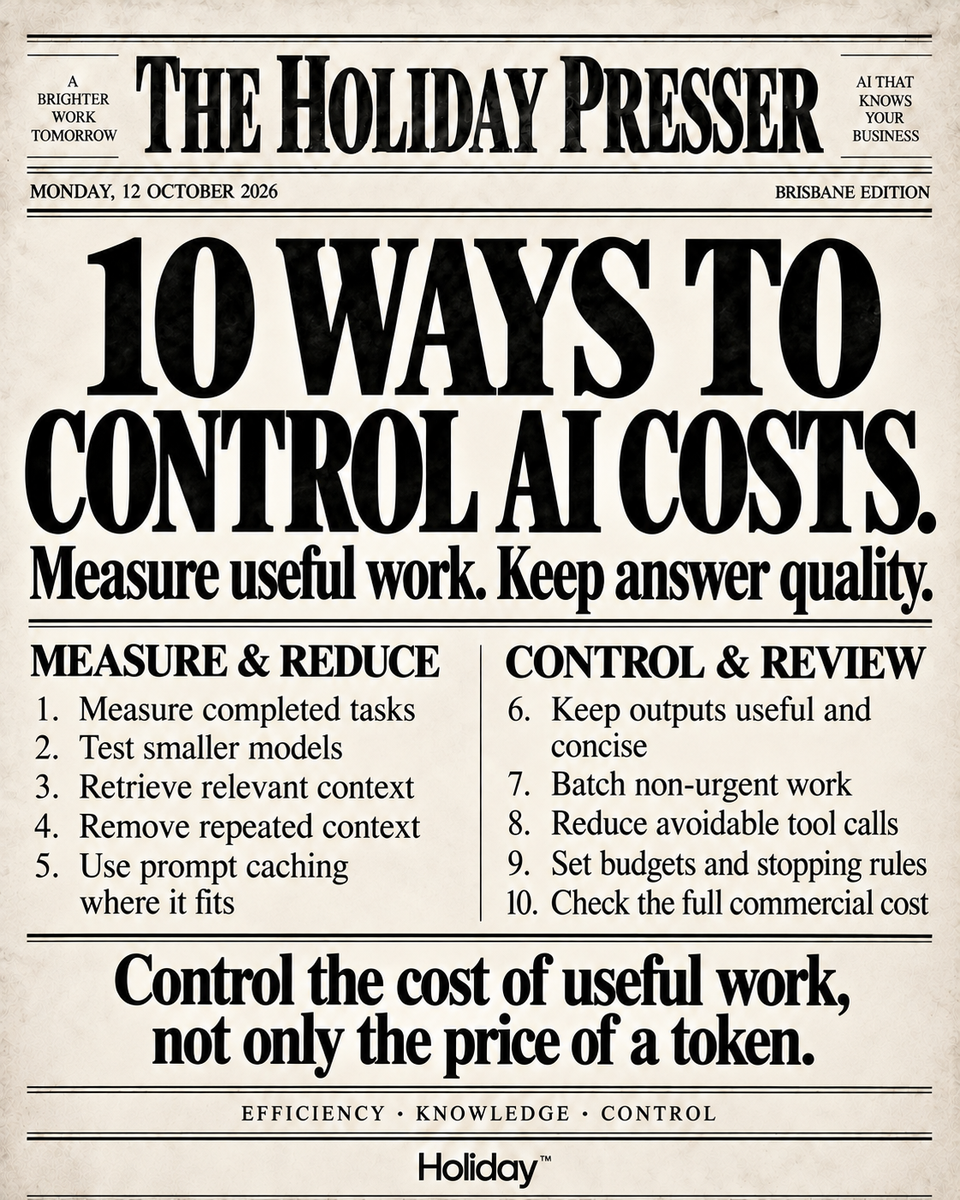
Control the cost of useful work, not only the price of a token
An AI bill is easier to manage when each cost is tied to a useful business result. A cheap request that misses the important information can create rework. An expensive request may also be doing work that a simpler process could handle. Start with a task, a quality standard and a budget. Then measure the whole workflow.
1. Measure a completed task
Record the input and output tokens, model, tool calls, retries and final outcome for a repeatable task. Compare the total cost of getting an acceptable answer, rather than only the cost of one request. Keep the test question and required information fixed when comparing approaches.
2. Use the smallest model that passes the test
A smaller model can reduce cost, but model choice should follow an evaluation. Test it against the same tasks, including missing information and conflicting records. Use a more capable model when the task needs it, not as a default for every step.
3. Retrieve relevant context instead of everything
An invoice question should not automatically require the full accounting database. Bring back the records and fields the task needs, while retaining enough context to check that the customer, company and invoice actually match. Less context is useful only if the answer remains complete.
4. Remove repeated context
Check whether each tool response repeats material the model already has. Use stable identifiers and avoid resending unchanged records where the workflow can safely refer to them. Keep any information needed to explain changes or reconcile conflicting sources.
5. Use provider prompt caching where it fits
Repeated instructions and stable context may be eligible for prompt caching. Put stable material where the provider expects it and changing material later. Check the provider's current cache requirements, pricing and retention settings before using it; a cache is not automatically appropriate for every request.
6. Ask for the output the business actually needs
If the task needs five fields and an exception note, ask for that rather than a long narrative. A concise output can reduce generated tokens. Do not remove the evidence or explanation needed for a person to review a decision.
7. Batch work that can wait
Non-urgent evaluations, enrichment and scheduled analysis may suit a provider's asynchronous batch API. Confirm its timing and supported features. Do not move a live customer task into a delayed queue just because the processing rate is lower.
8. Reduce avoidable tool calls
A workflow that repeatedly searches separate systems may spend tokens on navigation before answering the question. Compare that with a retrieval path that connects the relevant business records. Keep permission checks and freshness checks; fewer calls are not a reason to skip them.
9. Set a budget and a stopping rule
Give repeating AI work a spending limit and define what happens when it reaches it. Decide when a failed retrieval should retry, when it should stop, and when a person should review it. Unbounded retries can turn a small task into an unexpected bill.
10. Check the whole commercial model
Separate software and implementation charges from AI usage. Check for provider charges, markups, storage, integration and other operating costs. Holiday charges its AI usage credits at provider cost with no markup; that is not a claim that the entire service is free. Each company has its own environment.
Start with one measurable workflow
These controls are alternatives to buying a cheaper model and hoping for the best. Choose one business question, define a complete answer and compare the work needed to produce it. Holiday's latest internal efficiency study examines the access architecture in a controlled comparison. It should be read as a bounded internal benchmark, not a promise that every task will achieve the same saving.
Further reading: Holiday questions and answers.