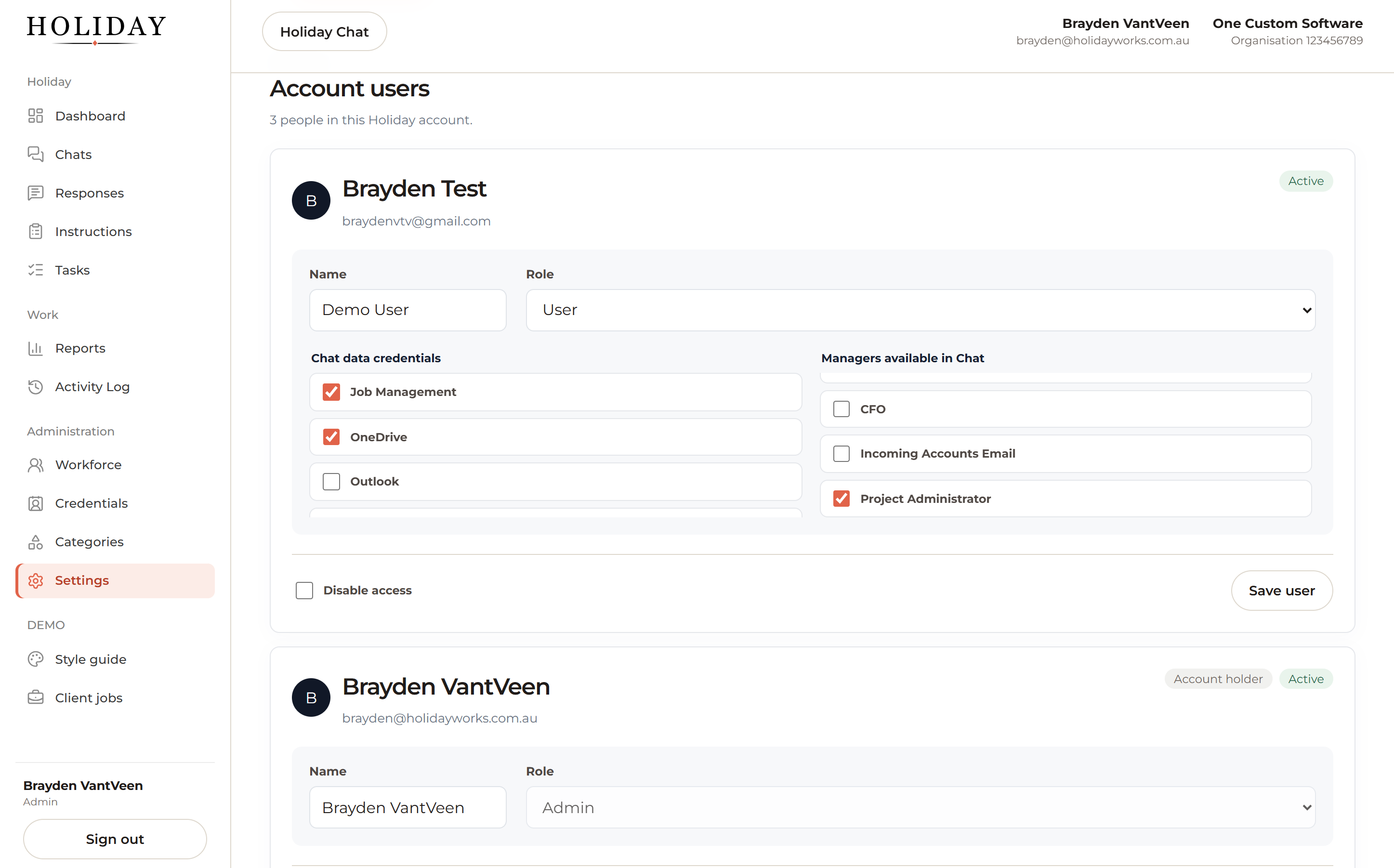
Holiday checks every tool call against both the AI identity’s
permissions and the requesting user’s permissions. Trust rules
enforced in code decide what can proceed, and every action is
recorded.
Make every identity, permission and action accountable.
AI is arriving through employee tools, software features and
autonomous services. As adoption spreads across departments, each
new entry point creates questions about access, cost and ownership.
Holiday ties approved AI work to an identifiable requesting user,
digital employee or specialist, defined authority and a visible
operating history. Models can request actions, but they cannot grant
themselves access.
The trust boundaries are enforced in the application layer,
independently of the model. Identity and access signals also help
teams investigate possible Shadow AI or unregistered agents.
AI activity
See exactly what was accessed, who instructed it, who reviewed it
and when it happened.
Holiday maintains a traceable record of AI activity across the
business, connecting each action to the responsible identity, system
access, human review and the time it occurred.
Governance reporting
Follow a task from instruction to outcome.
Review who started the work, what the AI accessed, which decisions
needed approval and what happened next.
Requesting user
Who requested or initiated the work.
Digital Employee identity
Which identifiable digital employee owned the work.
Specialist
Which specialist carried out the focused task, when used.
Model/provider used
Which AI model and provider performed the work.
Task/instruction
The job, prompt or instruction received.
Credential used
Which approved credential authorised access.
Systems accessed
Every connected application or service used.
Clients accessed
Which client records or workspaces were involved.
Data/sources accessed
Documents, records and information sources considered.
Actions taken
Every operation performed across connected systems.
Outputs produced
Responses, documents, updates and other deliverables.
Review required
Whether the work required human review.
Reviewer
Who reviewed the work and its supporting record.
Approval/rejection
The decision made and its approval state.
Escalations/reporting
Issues returned for attention and how they were reported.
Final outcome
What was completed, changed or resolved.
Timestamp/history
When each event occurred and the sequence of activity.
User and AI access
Verify both sides of every action.
Every tool call is verified: Holiday checks the AI
identity’s authority and the requesting user’s permissions every
time, before connected information or systems can be accessed.
User access
Business Chat: Ask questions across the systems
and data approved for their role.
Databases: Search only the connected records
they are permitted to use.
Digital Employees: Instruct only the digital
employees assigned to their account, team or work.
Work access: View and act on approved tasks,
clients, projects and responses.
AI access
Approved client data: Use only the client and
company information approved for its role.
No borrowed credentials: Reach systems only
through approved, scoped connections assigned to that AI
identity.
Database permissions: Read, create or update
only the permitted records and fields.
Container only: Operate inside the Holiday
environment without uncontrolled access across company systems.
Management decides how people reach AI and how AI reaches the
business.
Enterprise AI governance
Keep governance consistent as AI use expands.
Holiday works with the software a company already uses. As more
teams adopt AI, management can assign responsibilities, permissions
and budgets within the same controlled environment.
Leaders can see activity across approved people and digital
employees, investigate unusual access, and make changes without
rebuilding each team’s tools.